
The AI adoption playbook for engineering leaders
How to scale AI in your SDLC without sacrificing quality, control, or delivery predictability
AI adoption in software engineering is already underway in your organization.
Some of your teams are using copilots daily. Others are experimenting with agents. A few are quietly ignoring it.
Across most organizations, though, the pattern is familiar:
AI is increasing activity, but not consistently improving delivery.
We’ve seen teams generate more code and move faster in isolated parts of the SDLC using AI, while predictability slips, review queues lengthen, and quality becomes harder to manage. The underlying issue isn’t access to AI tools, but how AI implementation in engineering teams is structured across the SDLC.
We’ve created the perfect AI adoption playbook for software engineering teams and leaders.
Why AI adoption delivers uneven results
AI is an opportunity to improve software engineering productivity – but the impact isn’t consistent, and many AI adoption challenges in software development come from how it interacts with existing workflows.
Plandek’s Engineering Delivery 2026 Benchmarks Report, based on data from 2,000+ teams, shows a clear pattern: lower-performing teams see the biggest initial gains from AI.
Lower-performing teams usually have more obvious inefficiencies, so AI helps remove friction in execution. High-performing teams are already more efficient. They spend more of their capacity on value delivery – over 41% versus under 21% – and have fewer structural constraints to fix.
So the more useful leadership question is:
Where is capacity being lost in your SDLC today?
What we consistently see is:
teams with stronger delivery discipline compound gains across speed, predictability, and quality
teams with existing constraints increase activity without improving outcomes
bottlenecks do not disappear, they move
AI helps weaker systems improve faster. But it also raises the ceiling for teams that already convert engineering effort into value.
That is why the gap becomes more visible.
AI adoption is an SDLC change, not a tooling rollout
Most teams start in the same place:
give developers access to AI tools
encourage experimentation
wait for productivity gains
On the surface, that works. Engineers move faster and output increases. But what happens inside the delivery system is more complex.
Build speeds increase – GitHub’s research shows developers can complete tasks up to 55% faster with AI coding assistants – but:
review becomes a bottleneck
test coverage lags behind code generation
defect rates creep up
delivery becomes less predictable
We see this repeatedly across teams because AI accelerates one part of the SDLC, and the rest of the system has to absorb that acceleration.
If the surrounding workflow is not ready for it, you do not get end-to-end improvement. You get more queueing, more rework, and more coordination overhead.
That is why AI adoption is not just a tooling change. It is a change to how your SDLC operates.
How to adopt AI in software engineering: start with bottlenecks, not code generation
The most common starting point for AI adoption is code generation. It is visible, easy to measure, and produces immediate results.
But in most engineering organizations, it is not the primary constraint.
As Eliyahu Goldratt put it:
“An hour saved at a non-bottleneck is a mirage.”
In practice, we often see the real constraints elsewhere:
unclear requirements slowing delivery
→ teams spend cycles clarifying intent after work has already startedslow or inconsistent test creation
→ testing becomes a lagging function rather than a built-in quality gateoverloaded code review processes
→ senior engineers become throughput bottlenecksincident triage and root cause analysis
→ valuable engineering time gets consumed reactivelydocumentation and knowledge gaps
→ teams repeatedly rediscover context instead of building on itrelease coordination overhead
→ shipping becomes the slowest part of delivery
AI is most effective when applied to these friction points, because that is where it improves the flow of work through the system.
Build the right foundation before you scale
The organizations making consistent gains from AI adoption are not the ones moving fastest – they are the ones applying consistent AI engineering best practices early.
Set the context: AI is a force multiplier
Your teams will form their own narrative about AI if you do not provide one.
If AI is perceived as a surveillance tool, a cost-cutting mechanism or a threat to roles, adoption will be shallow, inconsistent, or resisted.
The more effective framing is straightforward: AI can expand what your engineers can get done, but it does not remove the need for judgment, context, or accountability.
That shifts the conversation from “should I use it?” to “where does it genuinely improve the work?”
Make experimentation safe, but structured
AI adoption is inherently experimental. Your teams need room to test workflows, compare outputs, challenge results, and share what is and is not working.
But safety on its own is not enough. In practice, teams need:
clearly defined use cases
explicit success criteria
visible sharing of learnings
Without that structure, experimentation stays local and never turns into organizational capability.
Put guardrails in place early
One of the fastest ways to derail AI adoption is to leave governance until later. Later usually means after something has already gone wrong.
At a minimum, your teams need:
human review requirements for production code
testing standards that scale with increased output
clear policies on data usage and model interaction
defined ownership for decisions and sign-off
AI increases both speed and variability. Guardrails are what let you scale it responsibly.
Measure AI impact in software engineering properly, or you’re guessing
Most teams start by measuring AI usage, rather than defining the right engineering metrics for AI adoption:
tool activation
prompt volume
AI-generated code
That is fine as a starting point. It is not where decisions should be made.
Usage tells you AI is present in your SDLC. It does not tell you whether it is improving delivery. The shift we see in higher-performing teams is that they stop looking at AI in isolation and start looking at how it changes the system.
1. Track AI adoption, but treat it as a signal, not an outcome
You still need to know what is happening on the ground:
Tool activation rate – are teams actually set up?
Active usage (DAU/WAU) – is this part of daily work?
Usage by task type – where AI is being applied across the SDLC
Prompt frequency – how deeply usage is embedded
Opt-out rates – where trust is breaking down
This gives you coverage. It does not give you impact.
We have seen teams with high usage and no delivery improvement. The difference is what happens next.
2. Look for changes in how work flows
If AI is working, it shows up in how your SDLC behaves end-to-end – not just in isolated gains.
In practice, you need a balanced view across four areas of delivery:
are teams spending more time on value delivery?
is work moving faster through the system?
are teams delivering more consistently?
is quality holding under increased throughput?
At Plandek, we group these into four core dimensions:
Focus – are you increasing time spent on value delivery?
Value Delivery %
Support and Maintenance %
Speed – is work moving through the system faster?
Lead Time to Value
Cycle Time
Time to Merge PRs
Predictability – are teams delivering more consistently?
Sprint Capacity Accuracy
Scope Change %
Quality – are you maintaining standards under higher throughput?
Stories Delivered : Bugs Raised
Bug Resolution Time
You’re looking for a consistent shift across the system.
3. Connect it to capacity and outcomes
This is where most teams stop too early.
The real question is whether AI is changing how much value your teams can deliver with the same capacity.
are you reducing unplanned work?
are you reclaiming time from rework and defects?
are you increasing roadmap delivery?
If those are not moving, AI has not yet changed your system in a meaningful way.
If you cannot connect adoption to flow, and flow to value delivery, you are not yet able to measure AI impact in software engineering effectively.Scaling AI across the SDLC with RACER
Scaling AI across the SDLC with RACER
Rolling out AI tools is only the first step in AI implementation in the SDLC. The harder part is turning rollout into measurable engineering and business results.
At Plandek, we use the RACER framework to think about that transition.
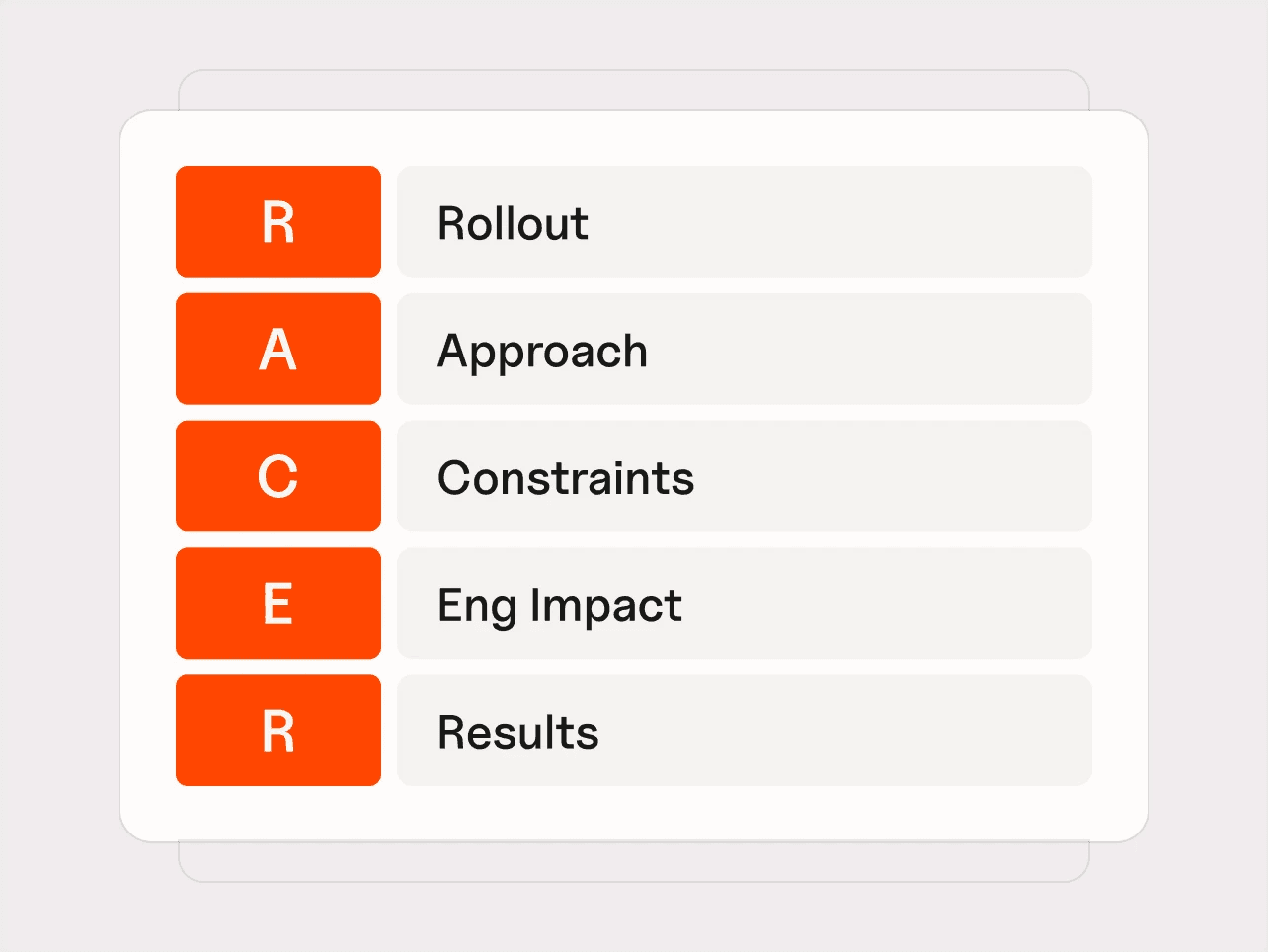
Rollout – are teams actually using the tools?
Approach – are they using the right AI approach for the task?
Constraints – what bottlenecks in the SDLC are limiting impact?
Engineering Impact – is AI improving focus, speed, predictability, and quality?
Results – is that translating into more value delivered and clearer ROI?
The framework matters because AI rarely stalls at rollout alone. More often, adoption is visible but impact is uneven because the approach is wrong for the task, or because existing delivery constraints become more obvious under higher throughput.
Rollout
The first question is whether your teams are using AI regularly enough for it to matter.
That means looking beyond licenses purchased and checking for real usage across roles, teams, and workflows. In practice, uneven rollout shows up quickly – power users emerge, casual users stall, and adoption varies sharply by function and seniority.
Approach
The next question is whether your teams are using the right AI approach for the work.
Not every task needs the same mode of AI support. Some work benefits from lightweight assistance. Some is better suited to supervised agentic workflows. Some tasks are structured enough for more autonomous handling.
The goal is not to standardize one pattern too early. It is to match the approach to the task and the level of risk.
Constraints
This is where the real work usually begins.
AI can speed up coding and testing, but that often exposes the next constraint in the SDLC:
slow code review
weak requirements
manual deployment steps
poor documentation
process friction
governance blockers
This is why AI adoption can feel underwhelming after the initial burst of excitement. The tools may be working, but the surrounding system is limiting the gains.
Engineering Impact
This is where you find out whether AI is actually improving software engineering productivity, using a consistent set of AI engineering productivity metrics.
For Plandek, that means tracking impact across the four pillars:
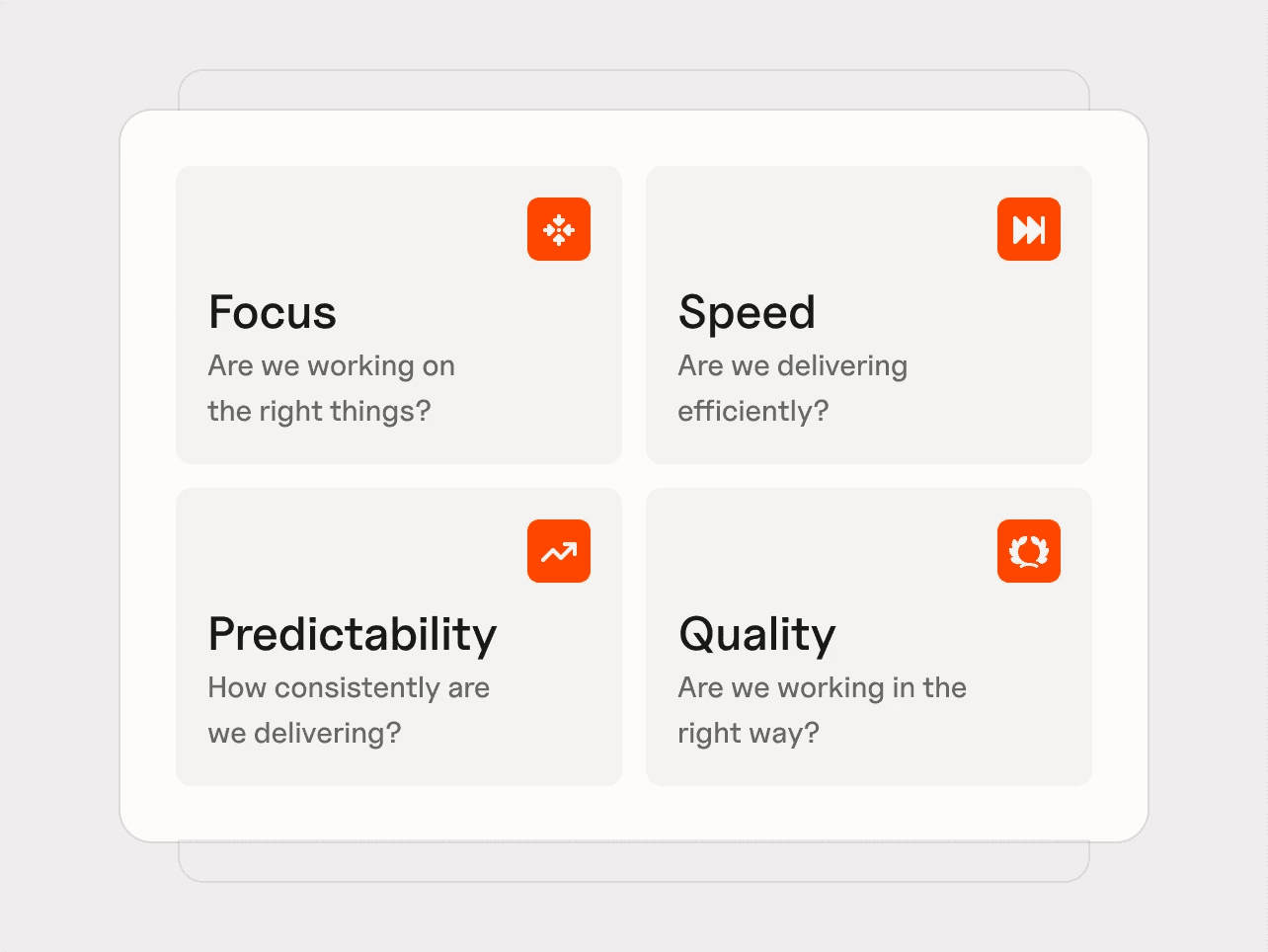
Focus – are teams spending more time on value delivery?
Speed – is work moving faster through the SDLC?
Predictability – are teams delivering more consistently?
Quality – is output improving without creating more rework and defects?
If those metrics are not improving, rollout and usage alone do not tell you much.
Results
The final question is whether engineering gains are turning into business results.
Are you:
increasing roadmap capacity?
reducing unplanned work?
accelerating time to value?
avoiding cost or creating room for growth?
That is the point of RACER. It gives leaders a way to move from rollout to results without mistaking activity for impact.
Where Plandek fits – from AI activity to real delivery impact
As AI adoption scales, most teams hit the same wall.
There’s more happening across the SDLC – but less clarity on what it’s actually changing.
more code generated
more PRs opened
more activity across teams
But no clear answer to the questions that matter:
is delivery actually faster end-to-end?
is quality improving – or quietly degrading?
is engineering capacity shifting toward value delivery?
And it’s the reason many AI initiatives stall after the initial rollout.
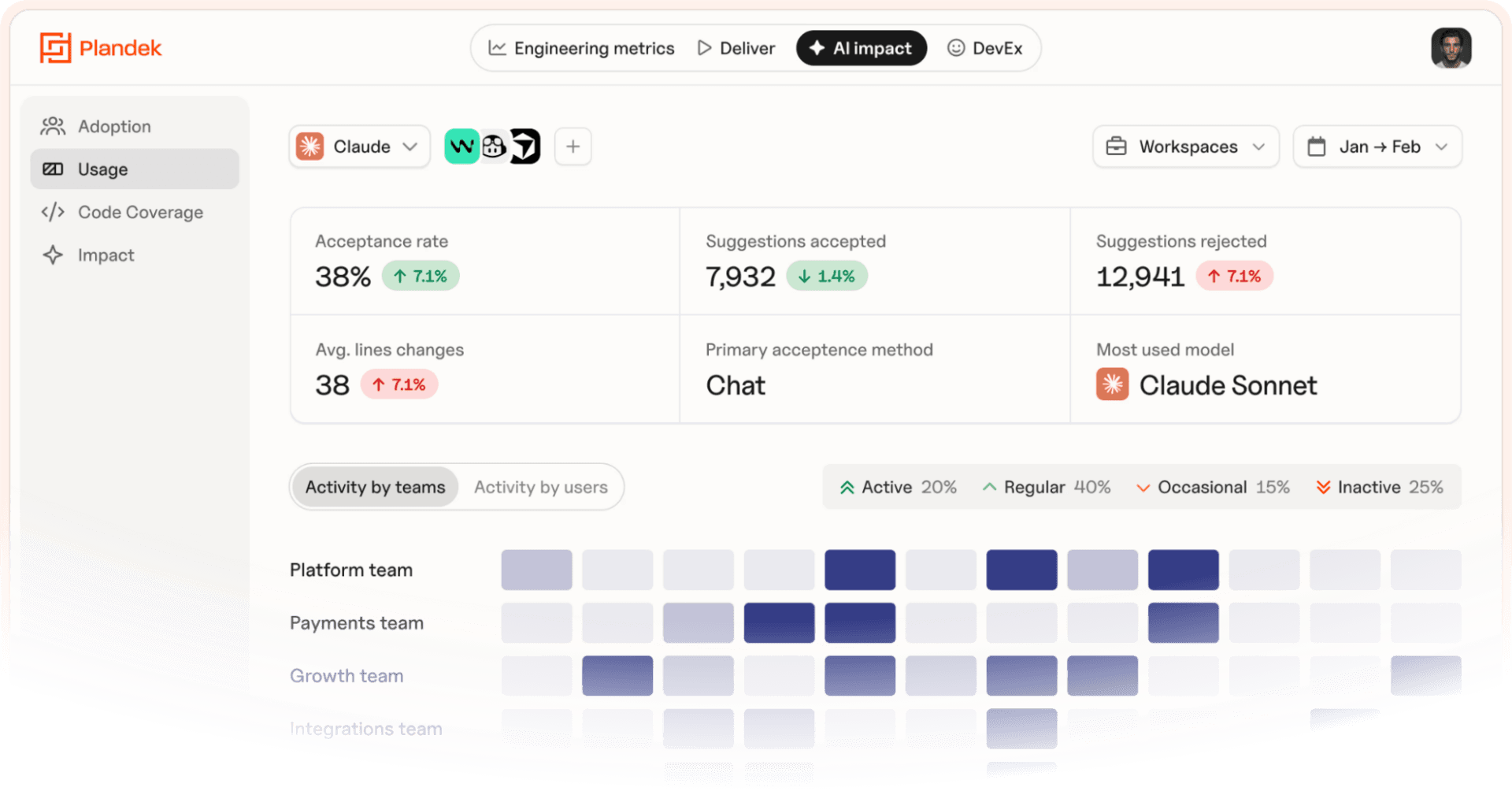
Plandek is designed to close that gap by connecting AI adoption directly to software delivery outcomes. Plandek integrates with AI coding tools like Microsoft Copilot, Claude,
Cursor, Windsurf and more
It gives you a system-level view of your SDLC, so you can see – in one place – how AI is affecting:
Focus – are you increasing time spent on roadmap work?
Speed – is Lead Time to Value actually improving?
Predictability – are teams delivering what they plan?
Quality – are you scaling output without increasing defects and rework?
Top teams deliver software 3x faster and spend twice as much time on value delivery. AI can help close parts of that gap – but it can just as easily widen it if you can’t see what’s happening across the system.
→ See how leading teams are using Plandek to measure and scale AI impact
The bottom line
AI is already embedded in your SDLC.
The question is whether it is helping your teams deliver more value with the same capacity – or simply creating more activity in the same system.
The leaders who succeed will not be the ones who adopt AI fastest. They will be the ones who:
apply it at the right points in the SDLC
address the constraints it exposes
maintain strong human ownership
measure impact end to end
That is how AI improves software engineering productivity in a way that actually shows up in delivery outcomes.
Key takeaways
AI adoption is a system change, not a tooling rollout
AI increases activity, but only improves delivery when flow improves
Bottlenecks don’t disappear – they shift across the SDLC
Code generation is rarely the constraint that matters most
Adoption metrics show usage, not impact
The real signal is more capacity spent on value delivery



See how your engineering efforts translate into measurable business impact
Measure delivery performance, AI impact, and engineering productivity with hundreds of metrics, OOTB dashboards and custom configurations.








NEW
Contact us
UK Office
Unit 313 The Print Rooms, 164-180
Union St, London SE1 0LH
US Office
Floor 4, 1515 Mockingbird Ln,
Charlotte, NC 28209, USA